
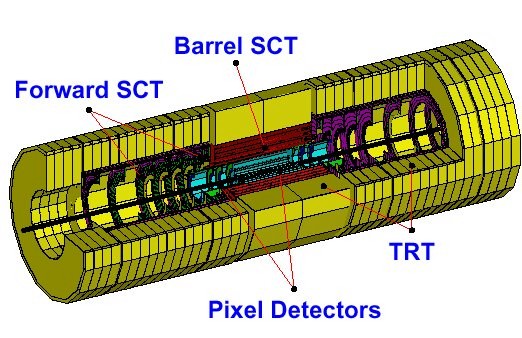
 Professor Mallik and her group joined the ATLAS experiment with SLAC at the end
of 2006. She and her group are involved in the Silicon Pixel detector, with Alex
Schreiner resident at CERN and fully involved in the DSP part of the project.
Apart from initial physics calibration of the detector with the early data, the
group is interested in Higgs and SUSY analyses.
Professor Mallik and her group joined the ATLAS experiment with SLAC at the end
of 2006. She and her group are involved in the Silicon Pixel detector, with Alex
Schreiner resident at CERN and fully involved in the DSP part of the project.
Apart from initial physics calibration of the detector with the early data, the
group is interested in Higgs and SUSY analyses.

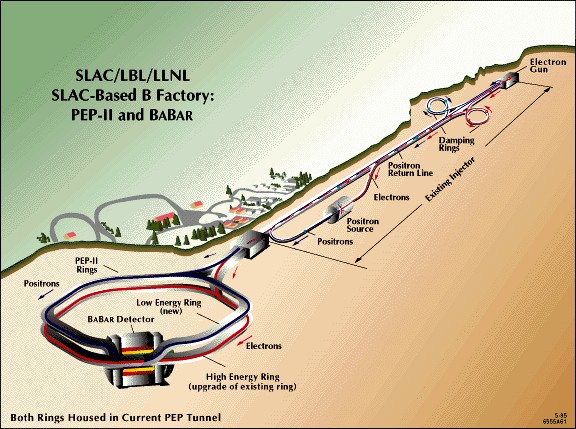 The BaBar detector at SLAC was operational in 1999 and collected 500 fb-1 data until 2008.
The detector is used to investigate the composition of matter using the B/B-bar system of mesons produced at the PEP-II collider at SLAC. It produced approximately xxx publications, mostly in Phys.ReV.Lett and others in Phys.Rev,
produced xxxx Ph.D.s and many excellent scientists.
The BaBar detector at SLAC was operational in 1999 and collected 500 fb-1 data until 2008.
The detector is used to investigate the composition of matter using the B/B-bar system of mesons produced at the PEP-II collider at SLAC. It produced approximately xxx publications, mostly in Phys.ReV.Lett and others in Phys.Rev,
produced xxxx Ph.D.s and many excellent scientists.
- Resposible for online trigger software system
- Central role in BaBar DAQ
- Level 3 trigger
- Level 1 trigger software
- Level 1 Trigger upgrade
- Trigger commissioner
- Trigger coordinator
- Run coordinator
- Construction of barrel electromagnetic calorimeter-mini crates and fanout boards
- Calibration of electromagnetic calorimeter, CARE chips
- Charmed Baryon Analysis Work leading to several "First Observations"
- Charm analysis working group coordinator

Professor Mallik and her group are also involved in the research and development of the Linear Collider, the next international highest priority construction project in Particle Physics. It will be central in understanding the Higgs mechanism (by which fundamental particles acquire masses), as a complimentary study of that at the Large Hadron Collider (LHC). Her group is very invloved in establishing a Particle Flow Algorithm for the ILC detectors.
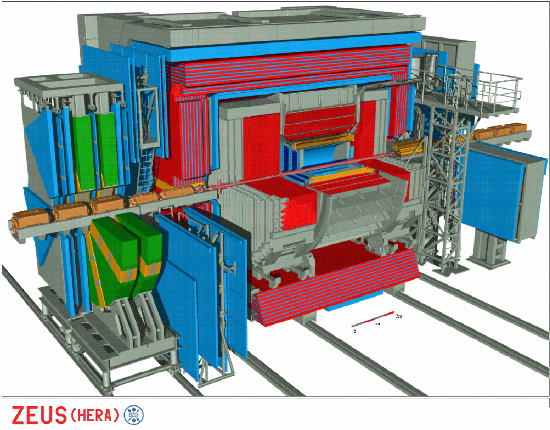 Zeus is one of the two experiments at HERA, the only high energy electron/proton collider opearating in DESY, located in Hamburg, Germany. The project started
in 1992 using Deep Inelastic scattering to probe the inner quark structure of
the proton. Professor Mallik and her group worked on the U-Sc calorimeter
online software and readout-electronics calibration. The group studied the rise
of the gluon momentum density at low-x from the rise of elastic and inelastic
charmonium production, calculated with perturbative QCD.
Zeus is one of the two experiments at HERA, the only high energy electron/proton collider opearating in DESY, located in Hamburg, Germany. The project started
in 1992 using Deep Inelastic scattering to probe the inner quark structure of
the proton. Professor Mallik and her group worked on the U-Sc calorimeter
online software and readout-electronics calibration. The group studied the rise
of the gluon momentum density at low-x from the rise of elastic and inelastic
charmonium production, calculated with perturbative QCD.